

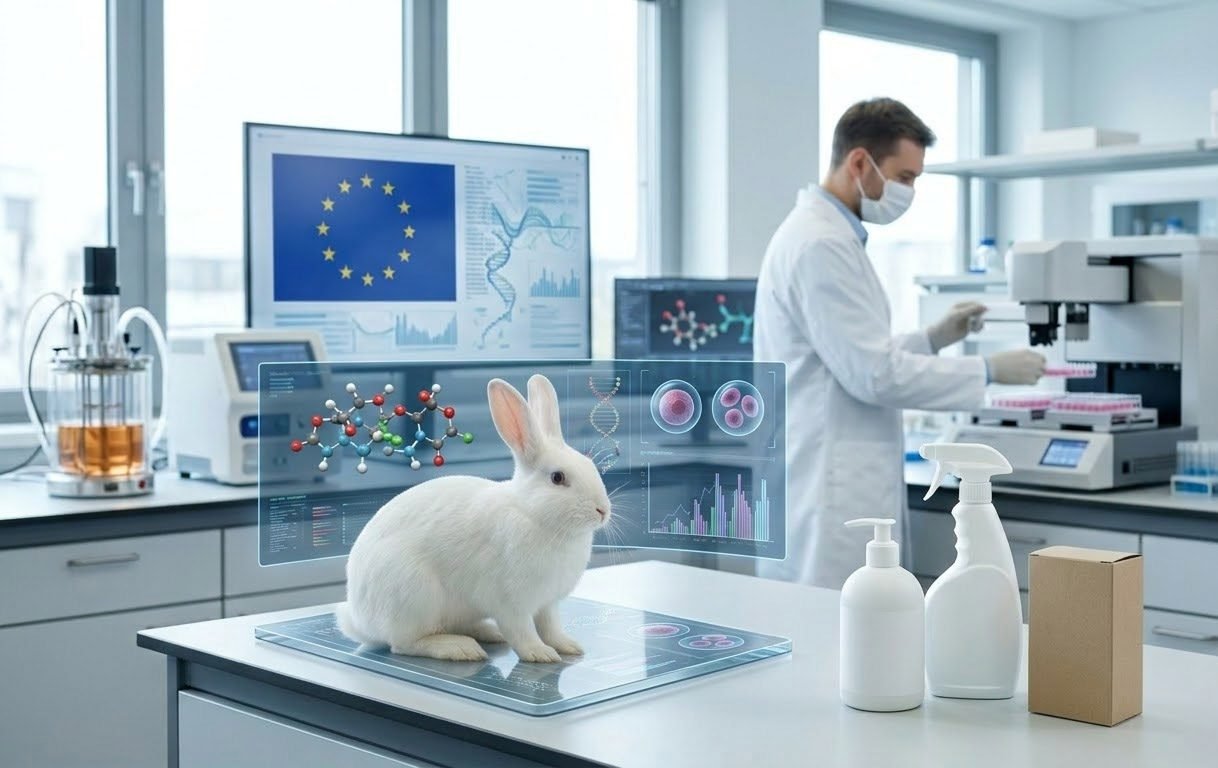
On March 2, 2026, the European Union officially published Regulation (EU) 2026/405, a landmark revision to the existing framework for detergents and surfactants. This legislation introduces a comprehensive ban on animal testing for both finished cleaning products and their individual ingredients, marking the first sector-specific prohibition of its kind since the 2013 cosmetics ban. While the regulation entered into force on March 22, 2026, a 42-month transitional period has been established, with the full prohibition becoming binding across all Member States by September 23, 2029.
Detailed Summary of Regulatory Shift
The new framework replaces the two-decade-old Regulation (EC) No 648/2004, modernizing the safety assessment process to reflect current scientific and ethical standards.
Modernizing Chemical Safety Frameworks
The core of the reform lies in its mandatory shift toward New Approach Methodologies (NAMs). Under the updated rules, safety assessments must rely exclusively on scientifically validated, non-animal methods. This includes:
- In-vitro testing: Utilizing human cell cultures and reconstructed tissue models to predict toxicological responses.
- In-silico modeling: Using advanced computational tools and AI to simulate chemical interactions within biological systems.
- Read-across techniques: Leveraging existing data from similar chemical structures to predict the safety profile of new substances.
Transition to Non-Animal Methodologies (NAMs)
The European Commission has been tasked with the urgent validation and promotion of these innovative methods. The transition is supported by the European Partnership for Alternative Approaches to Animal Testing (EPAA), which facilitates collaboration between regulators and the €41.2 billion European detergent industry. Manufacturers are now required to update their technical documentation and Digital Product Passports (DPP) to reflect compliance with these non-animal standards.
Regulatory Implementation and Timelines
The regulation permits the continued use of historical animal data obtained before March 22, 2026, to prevent redundant testing. However, no new animal experiments can be initiated for the purpose of meeting the requirements of the Detergents Regulation. While the ban is robust, animal welfare organizations such as Cruelty Free Europe remain vigilant regarding “exceptional circumstances” where the Commission may grant derogations for ingredients deemed essential for human health with no current alternatives.
Impact Assessment: Animal Welfare and Systemic Change
The implementation of this ban is a critical step toward reducing the use of sentient beings in European laboratories. According to the latest EU statistical reports, approximately 1.1 million animals were used for regulatory research and testing in 2022 alone.
- Sector Impact: Testing for household and industrial chemicals (including detergents) accounts for a significant portion of toxicological safety evaluations. By eliminating this requirement, it is estimated that thousands of animals, primarily mice, rats, and rabbits, will be spared from invasive procedures annually within the EU.
- Systemic Influence: This ban acts as a “test case” for the broader REACH Regulation revision. If successful, it provides the legal and scientific precedent needed to phase out animal testing across the entire chemical sector, which could eventually impact over half a million animals currently used for non-medicinal regulatory testing.
Beyond direct animal lives saved, the regulation forces a technological upgrade in the chemical industry. The mandate for NAMs accelerates the development of human-relevant science, which often provides more accurate safety data than traditional “animal models” due to physiological differences between species.
Global Perspective and Regional Significance
The EU’s decision is expected to trigger a “Brussels Effect” where international manufacturers must adopt animal-free testing to maintain access to the European market.
- Global Supply Chains: Non-EU manufacturers, particularly in the US and Asia, must now appoint EU-based representatives and ensure their testing protocols align with Regulation (EU) 2026/405.
- Legislative Momentum: This victory is a direct result of the European Citizens’ Initiative (ECI) “Save Cruelty-Free Cosmetics”, which garnered over 1.2 million signatures. It proves that public advocacy can effectively shift the EU’s legislative roadmap toward a fully cruelty-free scientific ecosystem.